

Search “Japanese chopper” and you’ll find two things: photos of impossibly clean custom bikes, and very little explanation of where they come from. Here’s the missing context — and how to end up riding one yourself.
A Nation That Modifies Everything
Postwar Japan became the largest motor vehicle producer on earth. But the interesting part isn’t how many machines the country built. It’s that Japanese owners started taking them apart again almost immediately.
Bosozoku bikes, kyusha-kai, kaido racers, lowriders, Hakosuka Skylines. Nobody accepted the shape they were handed. They cut it, stretched it, painted it, and made it theirs. Keeping a machine alive by hand, and improving it over years, is the same instinct that runs through Japanese craft — the sword, the plane blade, the tea bowl. It moved onto vehicles without changing character.
Then American custom culture arrived: strip a motorcycle down to nothing, stretch the front end, make it yours. American freedom of form met Japanese obsession with execution, and in the 1980s and 90s the two locked together. Japanese chopper culture was born at that intersection — not as an imitation, but as a fusion.
When the Culture Started Flowing Backwards
The proof is in Yokohama. Every December, the Hot Rod Custom Show fills a hall with hand-built machines, and builders from the US fly to Japan to show there — a complete reversal of how culture usually flows.
It hasn’t stopped. Born Free in California is now one of the most-watched custom shows in America, and this year the Japanese presence was hard to miss — builders who crossed the Pacific to display alongside the Americans who started all this. A Japanese chopper is no longer a local interpretation of an American idea. It’s part of the global vocabulary.
That’s why the phrase means something specific to riders everywhere: not a bike from Japan, but a philosophy — restraint, proportion, and craft over chrome.
The Aesthetic of Subtraction
Japanese design has always been better at removing than adding. Leave the empty space. Cut the ornament. Say it with what isn’t there. Zen translates surprisingly well into metal.
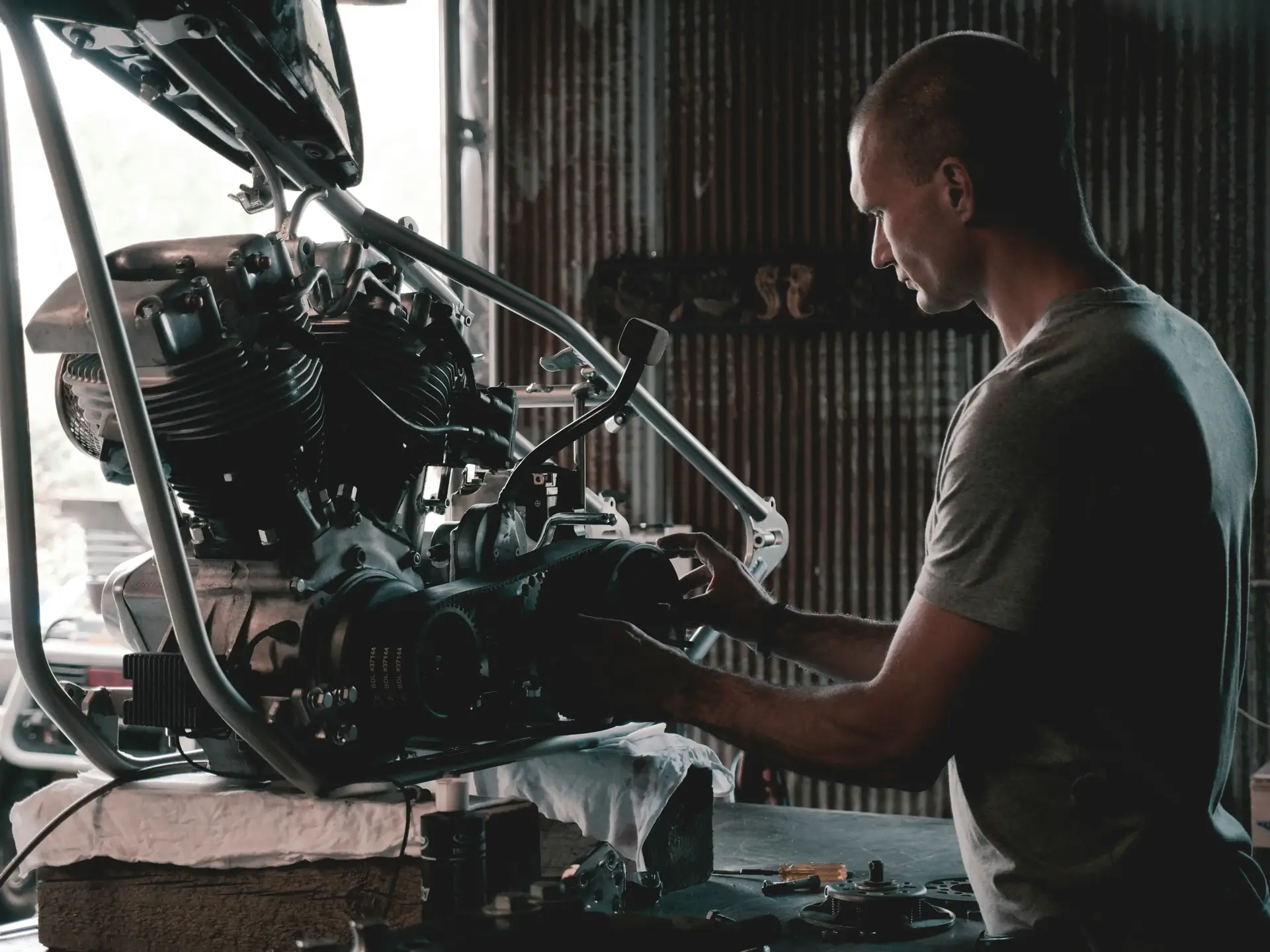
Builders here talk about the work the way people talk about meditation. Days spent moving a line a few millimetres, setting the angle of one bracket, taking things off. Adding parts makes a bike louder. Subtracting them exposes exactly what the builder finds beautiful, with nowhere to hide.
The rigid frame is that idea taken to its end. No rear suspension. Every seam in the road arrives in your spine. Subtract comfort — an actual function — and what’s left is the machine, the rider, and the road. Some kinds of focus are only available to people who chose the harder option.
What Makes Our Choppers Different
The bikes in our Kamakura garage sit in the middle of that story.
- All Sportsters. Every machine is built on an ‘88–‘99 Evolution Sportster 883 — among the more manageable Harleys, and easy enough to live with day to day. That’s part of why we can hand one to a different rider each morning.
- Rigid frames (hardtail). No rear suspension at all. Comfort is deliberately gone; in exchange the whole bike resolves into a single line. This is the backbone of the Japanese chopper, and we hand you the keys to it.
- One-offs, with names attached. Every bike credits its builder and its painter. These aren’t show pieces — they’re working machines with keys.
BEETLE RIDER is also the rental arm of OCEANBEETLE, a brand that grew up inside this culture. OCEANBEETLE made its name building vintage-style helmets — the kind you see at every custom show in Japan — with its own factory north of Tokyo handling everything from paint to CNC work. Collaboration runs with brands at the front of the scene sell out on release.
So what’s parked here isn’t a recreation of Japanese chopper culture. It’s the real thing, and you can ride it.
Ride a Japanese Chopper in Kamakura
Museums are fine, but a chopper only makes sense at speed — and Kamakura’s Route 134 might be the best road in Japan to learn that on: ocean on one side, Enoshima and Mt. Fuji ahead, an hour from Tokyo.
- The fleet — every machine, every spec, every builder credited
- The perfect one-day route — exactly how we’d spend the day
- License & IDP guide — what foreign riders need (short answer: a 1949 Geneva IDP with Category A)
Day rides start at ¥22,000. Multi-day is where it gets good — details on the FAQ page.
You came here asking what a Japanese chopper is. The honest answer: it’s what happens when a country that can’t leave machines alone spends forty years taking things off one, and it’s parked four minutes from Kamakura Station, waiting.